The most common thing said about getting around Albania is that there is no real system — that travelers are left improvising, and that anyone without a rental car is signing up for a logistics headache. That description misunderstands what is actually there. Albania’s transport network is real, and used daily by the overwhelming majority of Albanians who do not own cars either. It simply is not organized the way a visitor from a country with published timetables and centralized ticketing expects a transport network to look, and it does not live on a website. Once that expectation is dropped, the system underneath it turns out to be legible, forgiving of minor mistakes, and considerably cheaper than what it appears to replace.
Most of the confusion traces back to a single mismatch: travelers arrive looking for a hub-and-spoke model — one central station, one operator, one searchable timetable — because that is what public transport looks like in much of Western Europe. Albania’s network is closer to a set of overlapping local arrangements that happen to cover the entire country once they are stitched together, and the stitching happens through conversation rather than an app. That is a genuinely different skill to build on arrival, but it is a skill, not a workaround, and most visitors report picking up the basics within their first few journeys.
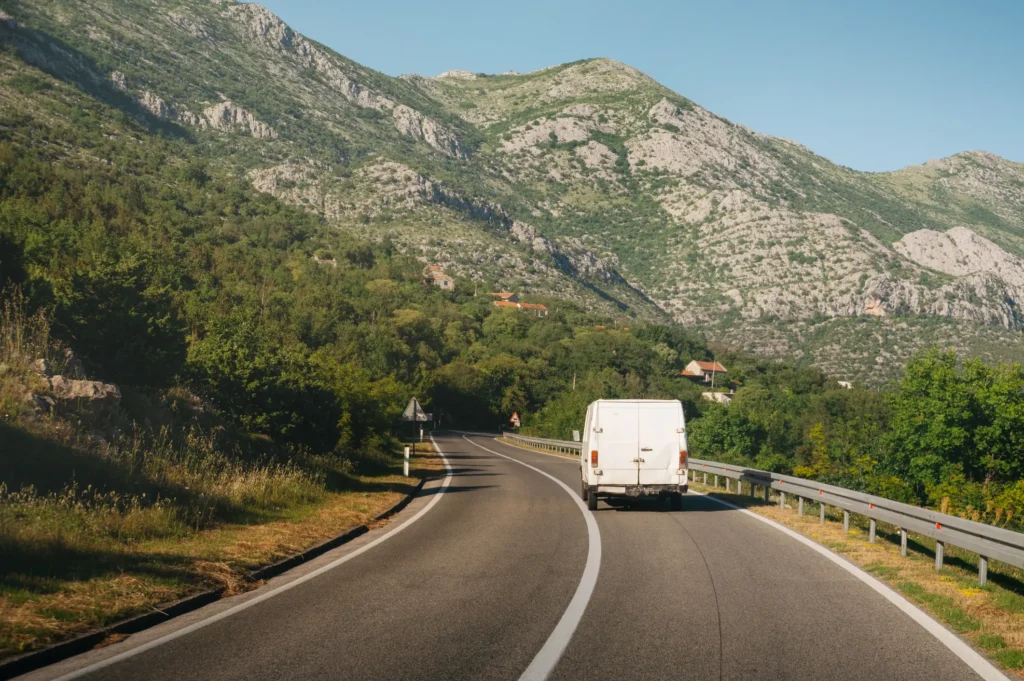
Furgons, explained properly. The word to learn before anything else is furgon — a shared minibus, typically a Mercedes Sprinter or similar van, that runs a fixed route between two towns and forms the actual backbone of Albanian domestic transport. Furgons gather at informal, locally known points rather than at purpose-built stations: sometimes a stretch of road near the edge of town, sometimes a spot by the market, sometimes, as in Himarë, near the intersection where the coastal road curves through town. There is rarely a sign. The reliable way to find the right spot and the right vehicle is to ask — a hotel receptionist, a cafe owner, or any local, since everyone in a furgon-served town already knows exactly where its vans leave from.
Boarding is first-come, first-served, with no reservation and no assigned seat. Furgons genuinely do leave when full rather than on a fixed clock, which means the wait at any given stand can run anywhere from ten minutes to the better part of an hour, and morning departures — broadly the seven-to-nine window — are consistently the most reliable, since demand and supply both peak early in the day. By mid-afternoon, gaps between departures widen and get harder to predict. Payment is to the driver directly, in cash, in lek, usually handed over as passengers board or disembark; there is no separate ticket counter for a furgon, and luggage typically rides in a rear compartment or a roof rack rather than a dedicated hold. The service is also seasonal in a way that catches some travelers off guard: furgons run frequently from June through September and considerably more sparsely — sometimes barely at all on less-traveled routes — from November through April, which is worth building into any shoulder-season plan. On the busiest coastal stretches in high summer, vans can fill fast enough that a would-be passenger watches two or three leave before finding a seat on a fourth; arriving at the stand rather than timing an arrival to a supposed departure is the more reliable habit. Luggage is rarely a problem in practice — drivers are used to travelers carrying everything they own for two weeks in a single bag, and a compact carry-on tends to move through this system with far less friction than a large hold suitcase would.
Coaches, for the longer and more touristed routes. Between Albania’s larger cities — Tirana to Shkodër in the north, Tirana down to Sarandë on the southern spine, and the routes connecting the coast to Berat and Gjirokastër — larger intercity coaches supplement the furgon network, generally with more comfortable seating and a slightly more fixed departure pattern, though still not one to book from home with full confidence. The practical difference from a furgon is mostly one of scale and formality: a coach is more likely to have a named operator and occasionally a ticket window rather than a pay-the-driver arrangement, and the coastal run down to Sarandë — famous for winding along the Llogara Pass above the Ionian Sea — comfortably occupies most of a day either way, whichever type of vehicle makes the trip. Tirana complicates this layer of the journey in one specific way: the capital has no single central bus terminal. Different companies and routes leave from different clusters around the city, with southbound and inland services toward Sarandë, Vlorë, Berat, and Gjirokastër generally departing from the area around the Zogu i Zi roundabout, and northbound services toward Shkodër departing from a separate cluster near the northern ring road. The international low-cost coach operator FlixBus has begun serving a limited set of Albanian routes as well, though its network here remains smaller than in Western Europe and should be checked directly rather than assumed. The one dependable rule across all of it: confirm the specific departure point with accommodation staff the evening before travel, since the informal geography of Tirana’s bus network shifts and does not reliably match what search engines index.
Inside the towns themselves. Once a furgon or coach has actually delivered someone to Gjirokastër, Berat, Himarë, or Sarandë, onward transport mostly stops mattering. The old towns and central districts that visitors spend the bulk of their time in are compact and walkable almost everywhere along this route, occasionally steep enough — Gjirokastër’s cobbled hill streets especially — that a lighter bag pays for itself twice over. Local taxis exist in every town of any size for the odd occasion a bag needs moving farther than feels comfortable to walk, generally arranged through a guesthouse or hotel rather than hailed on the street. The upshot is that transport planning in this part of the world is really only a concern on travel days themselves; the days spent inside a single town rarely require thinking about it at all.
Ferries, for the international hop. Albania’s southern coast connects directly to Greece by sea, and the short Sarandë–Corfu crossing is the clearest example. Multiple operators, including Ionian Seaways, Finikas Lines, and Albania Luxury Ferries, run the route, with crossing times ranging from roughly twenty-five minutes on the fastest boats to around an hour and a half on slower conventional ferries, depending on the vessel and the exact port used on the Corfu side. Frequency swings dramatically with the season: high summer sees crossings running close to thirty times a day between the two ports, while the off-season schedule can thin to one or two sailings daily. Fares are modest by international ferry standards — booking platforms list one-way tickets starting from around ten euros per adult in the cheaper season and vessel combinations — but exact pricing depends heavily on operator, season, and how far ahead a ticket is bought, so it is worth treating any figure as a floor rather than a quote. The crossing itself involves the same passport control as any international ferry — no vehicle to declare, no additional paperwork beyond what a land border crossing would require — which makes it one of the simplest international hops available anywhere on this coastline. For travelers extending the trip north overland instead of across the water, a similar version of this logic — leaving Albania without a rental car — is covered in Albania and Montenegro Overland.
The Tirana exception, and it is narrower than it looks. Travelers researching this before arrival often assume Uber or Bolt will cover the gap in cities the way they do elsewhere in Europe. According to a 2026 survey of ride-hailing coverage in the country, neither service operates in Albania, Tirana included — a combination of licensing rules that favor registered taxi operators and a market that has not drawn the international platforms in. What has filled that space instead is a set of homegrown ride-hailing apps: Clust, aimed squarely at tourists with an English-language interface and coverage across Tirana, Sarandë, Vlorë, Durrës, and Ksamil; Patoko, generally the cheapest option and strongest in Tirana, Durrës, and Vlorë; and Vrapon, which has the widest geographic reach of the three, extending into inland towns including Berat and Gjirokastër. Coverage thins outside the handful of cities each app supports — in smaller coastal towns, calling a local taxi directly by phone remains the norm. Installing one or two of these apps before landing, rather than counting on hailing a car on the street, is the closest Albania comes to the ride-hailing convenience common elsewhere, and it is genuinely useful for airport transfers and late-night trips within the cities it covers.
Money and a few words, before any of this works smoothly. Nearly everything above assumes cash in hand. One currency guide aimed at visitors puts it plainly: Albania remains predominantly cash-based, and the lek is the default for furgons, small guesthouses, and local eateries outside the most tourist-facing hotels and restaurants, even as card acceptance spreads through Tirana and the coastal resort towns. ATMs are common in cities and thin out quickly in smaller towns, so withdrawing enough lek to cover a few days at a stretch — rather than assuming a machine will be available exactly when needed — avoids most of the friction, along with the fixed per-withdrawal fee most Albanian ATMs charge foreign cards. A handful of Albanian words go a long way in the moments a furgon driver or coach conductor does not speak English: faleminderit (thank you), ju lutem (please), po and jo (yes and no), sa kushton? (how much does this cost?), and ku është? (where is?) cover a surprising share of the small transactional exchanges this kind of travel requires.
Habits that make it click. A short list, in practice: build a buffer day or a loose afternoon around any day involving a transfer, rather than booking a same-day onward connection that assumes everything runs on time; ask locally, the night before, rather than trusting a schedule found online before the trip; keep small-denomination lek on hand at all times, since exact change is often expected and rarely available; treat any departure time as an estimate rather than a promise, because that is what it actually is; and download a ride-hailing app or two before landing rather than after a late arrival makes it urgent. None of this requires fluency in Albanian, a data plan, or a rental agreement — just a willingness to ask a short question and wait for an honest answer instead of a printed timetable.
Closing. None of this amounts to a system in the sense that a traveler from a country with centralized rail and bus authorities might expect, and it does not need to. It is a system built on local knowledge instead of a booking platform, and once that knowledge is picked up — usually within the first two or three journeys — it runs about as smoothly as anything with a website, at a fraction of the cost of the rental car it replaces. The friction is real but front-loaded: the first furgon is the confusing one, and every one after it is just a furgon. Readers weighing whether to build a trip around this network at all might start with Albania in Two Weeks, Without a Car, which lays out what a full loop looks like once the furgons, coaches, and ferries described here are actually put to use.
Sources
- Albania Furgon Guide: Shared Vans on the Riviera
- Uber & Bolt in Albania 2026: Neither Works (Use This)
- Albania Bus Routes 2026: Schedules, Prices and Terminals – Albania Spirit
- Sarandë – Corfu ferry, tickets & schedules | Ferryhopper
- Money in Albania (2026): Cash, cards, ATMs & tourist payment tips – Lovealbania
- Helpful Albanian Words & Phrases for Tourists to Know