Most Albania itineraries online are written from behind a windscreen. A hired car lets you move from the Alps to the Riviera in a fortnight and makes it look effortless, because it very nearly is. This guide covers the other version: two weeks without a car.
This route assumes you don’t have one — no rental, no ride-share, just furgons, buses and one memorable ferry. That single constraint changes the map more than any guidebook admits, and it’s worth understanding before you book anything: it forces a choice between breadth and depth, and this guide is built around taking depth.
Two practical notes before you book: pack light, since two weeks in a single carry-on is realistic on this route and makes every furgon transfer easier — and don’t let going car-free put you off going alone, either, since the furgon network is intuitive enough that this works well as your first solo trip.
What two weeks without a car actually buys you
Albania runs roughly 340 km end to end. In a car, crossing it is a long but ordinary day. On public transport, moving between the far north and the deep south costs the better part of two days each way, because most routes funnel through Tirana and connections rarely line up cleanly.
Try to fit the Albanian Alps and the Riviera into fourteen car-free days and you’ll lose three or four of them to transit, arriving everywhere tired to see two regions half-well. So this route weights the north instead: it gives the Alps — including the walk between Valbona and Theth — the days they need, then descends slowly to finish in Berat rather than racing for the coast.
The trade-off is real. You give up Sarandë, Ksamil and Gjirokastër entirely. There’s a version of this route for people who’d rather make the opposite call, further down.
Before anything else: how Albanian transport actually works
Four things matter more than any single day’s itinerary.
Furgons are shared minibuses, and they leave when full — not on a timetable. Morning departures, roughly 6–10am, fill quickest. An afternoon furgon can mean a 30–60 minute wait for the last seats.
Tirana has no single bus station. Departures cluster by direction rather than one central terminal: a southern and eastern zone (historically near the old stadium area) for Berat, Vlorë, Sarandë, Gjirokastër, Korçë and Elbasan; a northern zone for Shkodër and Lezhë; and, since a 2024 reorganisation, a growing share of departures from the TEG shopping centre on the Tirana–Durrës highway. A consolidated terminal near Kamza has reportedly been in progress for some time. This is the single most changeable fact in this guide — confirm your departure point with your accommodation the night before, which is standard practice here, not a sign of poor planning.
Cash only, small notes. Furgons and most local buses take lek, paid to the driver or conductor once you’re moving.
Don’t plan around trains. Passenger rail is effectively non-functional at the time of writing. A Tirana–Durrës–airport line has reportedly been under construction, with an opening pencilled for sometime around 2026–2027 — check current status before you rely on it.
Pack light for all of this: furgons have limited luggage space and you’ll be changing vehicles more than once. Our guide to packing two weeks into a single carry-on covers what that actually takes.
The route at a glance
| Days | Where | How you get there |
|—|—|—|
| 1–2 | Tirana | Arrive |
| 3–5 | Shkodër | Furgon, ~2–2.5 hrs |
| 6 | Koman ferry → Valbona | Van, ferry, van — a full day |
| 7–8 | Valbona | — |
| 9 | Over the pass to Theth | On foot, ~6–9 hrs |
| 10–11 | Theth | — |
| 12 | Back down to Shkodër | Van, half a day |
| 13–14 | Berat | Bus via Tirana |
Days 1–2 — Tirana
Two days is enough to get past the highlights without rushing them.
Skanderbeg Square is the natural starting point — the national hero’s statue, ringed by the National History Museum and the city’s major cultural buildings. From there, two very different communist-era sites are worth the contrast: Bunk’Art 1, a five-storey former nuclear bunker turned museum on the regime and its secret police, and The House of Leaves, a former surveillance villa that still holds wiretapping equipment and hidden cameras — smaller, quieter, and for some visitors more unsettling than the bunker.
For scale and lightness after that, the Pyramid — built in 1988 as Enver Hoxha’s mausoleum, now reworked into a creative and digital learning space with rooftop access — sits a short walk from Blloku, once the sealed-off enclave for party elites and now the neighbourhood with the city’s best cafés.
Use part of day two on logistics: confirm where your northbound furgon leaves from, and if you’re travelling June to September, book the Koman ferry now rather than later.
Days 3–5 — Shkodër
Roughly two to two and a half hours north by furgon. Three nights here is more than most itineraries allow, and it’s the right amount — Shkodër is flat and easy to cycle (many guesthouses lend bikes), with a lake on one side and Rozafa Castle above the confluence of the Buna and Drin rivers.
The castle carries a well-known local legend: three brothers, building the fortress, found their walls collapsing every night, until a wise man told them the walls needed a human sacrifice. The youngest brother’s wife, Rozafa, arrived the next morning with their food, unaware of the plan — and asked only that her right eye, hand, foot and breast be left uncovered so she could still see, nurse and comfort her infant son as she was built into the wall. What remains today is 13th-century church ruins, an Ottoman-era mosque, a small museum, and — from the walls — a view over both rivers, the city, and the Albanian Alps you’re about to walk into.
Keep the third day unstructured. The next one is long.
Day 6 — The Koman ferry
This is the day the trip changes register.
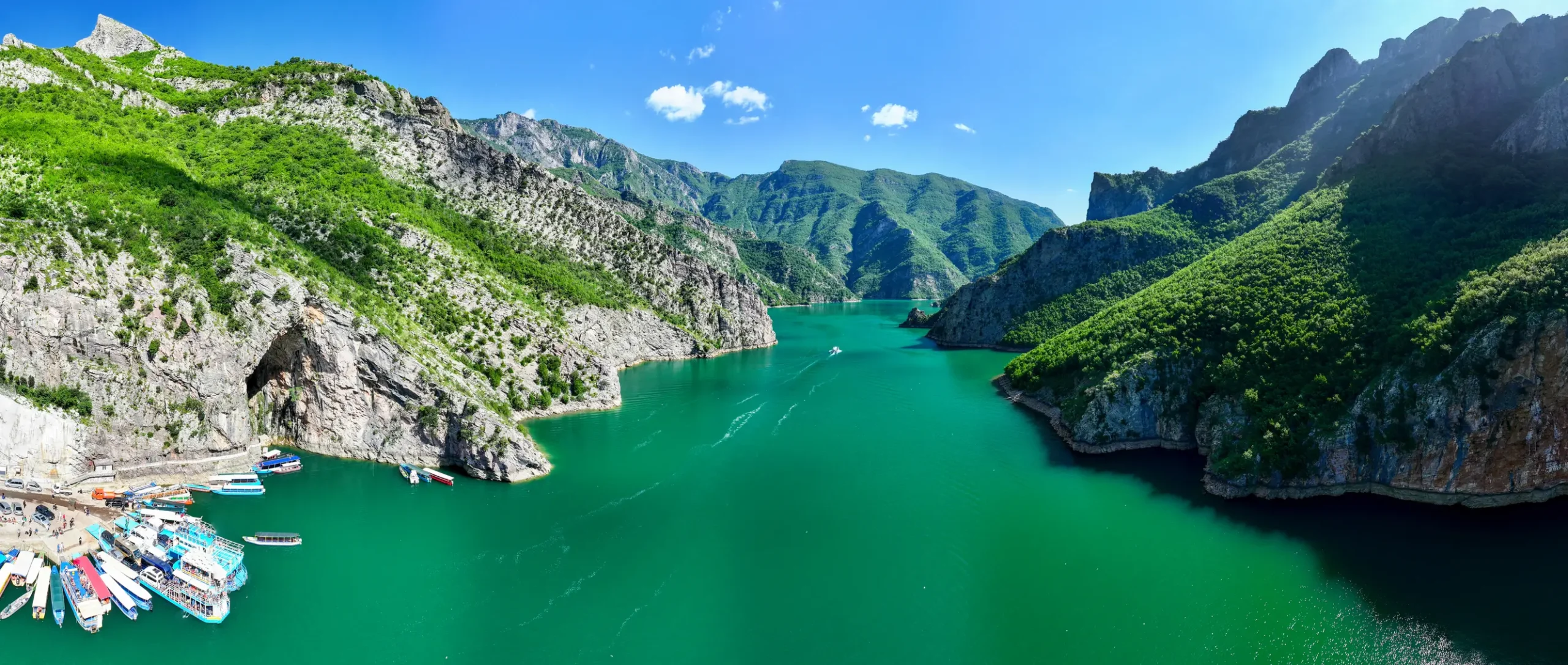
A van collects passengers from Shkodër early — before sunrise — for the drive to Koman, itself part of the experience: a switchbacked road through the hills before the water appears. The ferry then crosses a reservoir carved between near-vertical rock walls for two to three hours, with nothing to do but watch it happen.
The main boat has typically departed Koman around 09:00, with the return run from Fierza in the early afternoon; fares have run somewhere between 700 and 1,500 lek depending on the boat and operator, and the two names most commonly cited are Berisha and Dragobia. In July and August, book ahead — this route is reported to fill completely in high season, and turning up without a reservation is a real risk in those months. Confirm current times and prices directly with the operators before you travel, since both shift year to year.
From Fierza, a van continues to Bajram Curri and on up the valley to Valbona — a long day that ends somewhere very quiet.
Days 7–8 — Valbona
Valbona Valley runs on guesthouses rather than hotels, most well above 900m elevation, several operating since the early 1990s. Rates for a private room have been quoted from around €35 a night; ask when booking whether dinner and breakfast are included, since half-board is common in the valley even if not universal. Two days here is rest before the crossing — short walks along the valley floor are the usual way to spend them, rather than anything strenuous.
Day 9 — Over the Valbona Pass to Theth
The crossing covers roughly 14.7 km and typically takes six to nine hours. Walk it Valbona to Theth rather than the reverse — the descent into Theth is reported to be considerably easier on the knees than the descent into Valbona, and the whole route runs faster in this direction.
The pass is only safely open roughly June to October, and in recent years hasn’t reliably cleared until the second week of June. Outside that window this stops being a hard hike and becomes a genuinely dangerous one — there have been fatalities in May from hikers attempting it before the snow cleared. If your dates fall outside the season, take the van around instead; this is not worth negotiating with yourself about.
Days 10–11 — Theth
The village centres on a small 1892 stone church with a shingled bell tower — the most-photographed structure in the valley, and worth the 20–30 minutes it takes to see properly. Nearby, the Lock-in Tower (Kulla e Ngujimit) is a stone refuge tower tied to the Kanun, the region’s traditional code of law: men caught in blood feuds would confine themselves inside until a feud ended or reconciliation was reached. It now operates as a small museum on that history.
Two walks are worth the two days: the Blue Eye of Theth, a vividly turquoise spring pool down the valley near Nderlysa, reached via a half-to-full-day walk through a forested gorge; and the Grunas Waterfall, about 2 km south of the village, dropping roughly 25–30 metres into a cold pool, usually a 2–3 hour round trip and often combined with the canyon below it.
Day 12 — Back down to Shkodër
A shared van retraces the route to Shkodër, roughly half a day including stops.
Days 13–14 — Berat
Reaching Berat means returning through Tirana: roughly two hours down from Shkodër, then close to two more south, on a route quoted around 400–600 lek for the second leg.
Berat earns its nickname — “the city of a thousand windows” — from tiers of white Ottoman houses stacked up the hillside toward the castle, each studded with rows of windows that catch the light at close range. Unusually, Berat Castle (Kalaja) is still inhabited: families live within its walls alongside Byzantine churches and the Onufri Museum, home to 16th-century icons by the painter whose name it carries.
The Mangalem quarter, on the castle side of the river, is the most-photographed angle and holds the 1492 King Mosque; across the Gorica Bridge, the quieter Gorica quarter gives the classic frontal view of the windows themselves. A last evening on that bridge, looking back at the hillside lit up, is the usual way this route ends.
What this itinerary leaves out
Sarandë, Ksamil, the Riviera beaches, Gjirokastër, Butrint, Korçë and Lake Ohrid. That’s a genuine amount of the country, and if beaches are the reason you’re going to Albania, this isn’t the right route — better to know that now than on day nine. That list is the real cost of two weeks without a car.
If you’d rather have the coast
Split the difference at Shkodër. Do Tirana, Shkodër, the ferry, Valbona and Theth in nine days, then take the long bus south — Tirana to Sarandë has run around five hours for roughly 1,200–1,500 lek — and give the remaining five days to the coast and Gjirokastër. You’ll see more of the country and know less of any single part of it. That’s the honest trade — two weeks without a car simply sets a lower ceiling on ground covered.
What it might cost
These figures come from published country-level budget data for Albania, not a receipt from this specific trip, so treat them as a planning range rather than a promise. General daily averages have been reported around $35 (≈3,100 lek) per person per day for a budget traveller, covering roughly $30 for a shared double room per night and around $21 a day on food (breakfast $4–6, dinner $8–17, coffee about $2).
Layer the specific transport in this route on top of that: the Tirana–Shkodër furgon (500–700 lek), the Koman ferry (700–1,500 lek), and the return legs to Berat (400–600 lek) add up to roughly 2,000–3,500 lek — call it €18–32 — in point-to-point fares across the fortnight, before the vans linking the ferry to Valbona and Theth back to Shkodër, which are usually bundled informally with the ferry trip or arranged locally.
Put roughly together, a budget-conscious two weeks on this route — shared rooms, local food, the fares above — lands somewhere in the region of €500–750 per person, before flights. Mid-range comfort (private rooms throughout, more restaurant meals) pushes that closer to €1,000–1,400.
Practical notes
When to go. The pass decides it: June to early October. Late June and September are the usual sweet spots — after the worst heat, before anything closes for the season.
Cash. Lek, small notes, more than you’d expect in the north where cards are less reliable.
Language. Have your destination written down (Albanian or on your phone) before you approach a furgon — drivers and conductors often speak limited English.
Booking. Domestic furgons and buses are turn-up-and-pay. The Koman ferry in July–August is the one exception worth booking ahead.
Going alone? The logistics here don’t really change solo — furgons and shared guesthouses put you around other travellers by default. Read our first-timers’ guide to solo travel if it’s your first trip alone.
The parts of this route that change every season. Ferry times, current Tirana departure points, and trail conditions on the pass — rechecked and sent out before each summer. Goes out with the Sunday Morning Dispatch.